
Business Membership Spotlight: Walsh Construction Co.

Oregon Tradeswomen, Inc. welcomes the support of the business community to help us fulfill our mission to engage more women in the trades.
Walsh Construction Co. is one of our partners in this program and we thank them for their contribution to OTI.
“It started in 1961 when two young brothers, Tom and Bob Walsh, who had an idea for a business, created Walsh Construction. They were college students with limited funds, so the shoe box served as their filing cabinet and the Chevy van as their transportation.
Over the years, they made smart decisions, seized opportunities, developed innovative approaches, and asked people who shared their passion for building the Northwest to come along with them as they grew into something extraordinary.
Those characteristics endure to this day. At WALSH, we’re always focused on building Smart, building Green and building Community. Just as importantly, we’re focused on the people who join us for the ride.”
OTI thanks the staff of Walsh Construction Co. for their support of our programming as a business membership program participant!
If you want to learn more about our business membership program, please send an email to dennise@tradeswomen.net for details on how you can be involved.
Congratulations Trades and Apprenticeship Career Class Graduates!
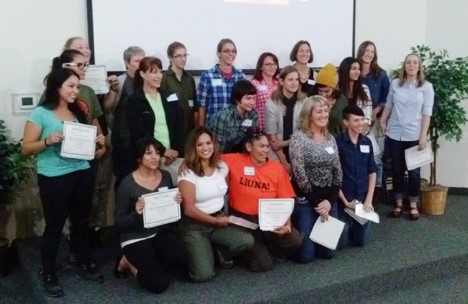
Oregon Tradeswomen, Inc. cordially invites you to attend our Trades and Apprenticeship Career Class Graduation!
Date:
Thursday, December 10, 2015
Time:
5:30 – 6:30 p.m.
Location:
The Auditorium
PCC Metro Workforce Training Center
5600 NE 42nd Avenue
Portland OR 97218
Click for the street address on Google Maps
Light appetizers & cake will be served
Fall 2015 TACC Graduates and Their Trade Goal
Cherokee Andrade – Tree Trimmer
Ashley Cooper – Sheet Metal Worker
Debra Crowley – Carpenter
Ali Foster – Carpenter
Felicity “Fuzz” Jackson – Carpenter
Hannah Johnsen – Carpenter
Bre Lackey – Sheet Metal Worker
Alex Mays – Electrician
Jamie Metcalf – Environmental Remediation
Rachel Meyer – Tree Trimmer
Carlee Ogle – Carpenter
Sara Quinn – Electrician
Yolanda Sandoval – Electrician
Maija Schurter – Carpenter
Misty Sedotal – Carpenter
Mercy Shammah – Carpenter
Crystal Siltman – Sheet Metal Worker
Rose Swartz – Carpenter
Kelsey Wollam – Pile Driver
Funding for our program is provided by:
Advantis GROW Community Fund, Bank of America, The Boeing Company, Construction Apprenticeship & Workforce Solutions, Inc. (CAWS), the Environmental Protection Agency, H.W. Irwin and D.C.H. Irwin Foundation, Hoover Family Foundation, Kaiser Permanente Community Fund at the Northwest Health Foundation, Multnomah Bar Foundation Multnomah County, Oregon Department of Transportation, Pacific Power Foundation, Penney Family Fund, a member of The Common Counsel Foundation, the Portland Development Commission’s Economic Opportunity Program, Stimson-Miller Foundation, The TJX Foundation, U.S. Bank, The Portland Water Bureau and Hoffman Construction through the Community Benefit Agreement, Wells Fargo, Women’s Bureau–U.S. Department of Labor, Women’s Foundation of Oregon, Worksystems, Inc., industry donations, and individual tradeswomen and supporters.
OTI In the News in November

Wow! Oregon Tradeswomen was in the news multiple times earlier in November! We made a lot of noise about the first ever National Women in Apprenticeship Day, and we invited members of the media to visit our Trades and Apprenticeship Career Class during their hands on learning days when they were hard at work deconstructing and demolishing the interior of the former ‘Sugar Shack’. This work opportunity was made possible through our partnership with Living Cully – an innovative collaboration between non-profit organizations in the Cully Neighborhood in NE Portland: Verde, Hacienda CDC and NAYA (Native American Youth and Family Center).
Women in Apprenticeship Day
Oregonian
Daily Joural of Commerce
NW Labor Press
Deconstruction of Sugar Shack
Daily Journal of Commerce
KATU
KGW
Portland Business Journal
PQ Monthly
Partner Spotlight: Sheet Metal Institute
Oregon Tradeswomen, Inc. is most grateful for the support of community and industry in our work in promoting the success for women in the trades through education, leadership and mentorship. We do this, in large part, working with our partners in a variety ways, including the coordination of field trips for our Trades and Apprenticeship Career Class participants.
TAC class is a free, 7-week, pre-apprenticeship training class that helps women prepare for a high skill, high wage career in construction. Over the course of the session, women visit several sites like the Sheet Metal Institute.
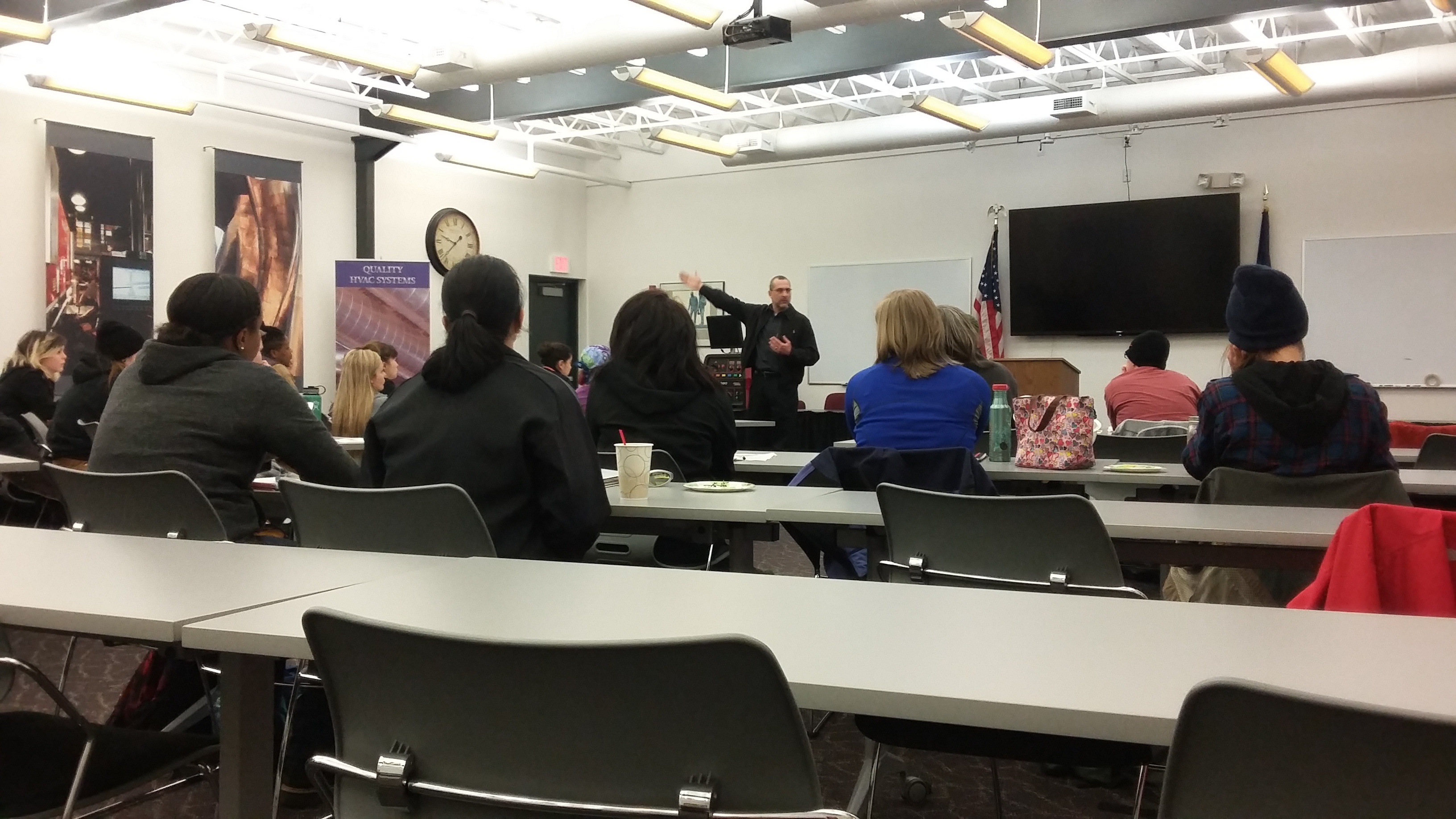
The center is a registered non-profit joint labor-management training trust between the Sheet Metal Workers Local Union #16 and Sheet Metal and Air Conditioning Contractors’ National Association – Columbia Chapter. It offers approved training programs in three occupations including Sheet Metal Worker, Sheet Metal Worker Service Technician and Residential Sheet Metal Worker.
Kim Neel is a career counselor and job placement specialist for OTI. She coordinates the field trips and I asked her to share some thoughts about our appreciation for the center and the employees who operate it:
“I always make it a priority to make it to the Sheet Metal Institute, because so often many women do not understand what sheet metal workers do. Kevin does a remarkable job of walking them through the process of understanding the scope of the industry as well as its history. He has a great way of getting our students excited not only about the variety of the work, but also the mathematical and mental challenges it brings. They are naturally drawn to the industry because of his organized delivery.
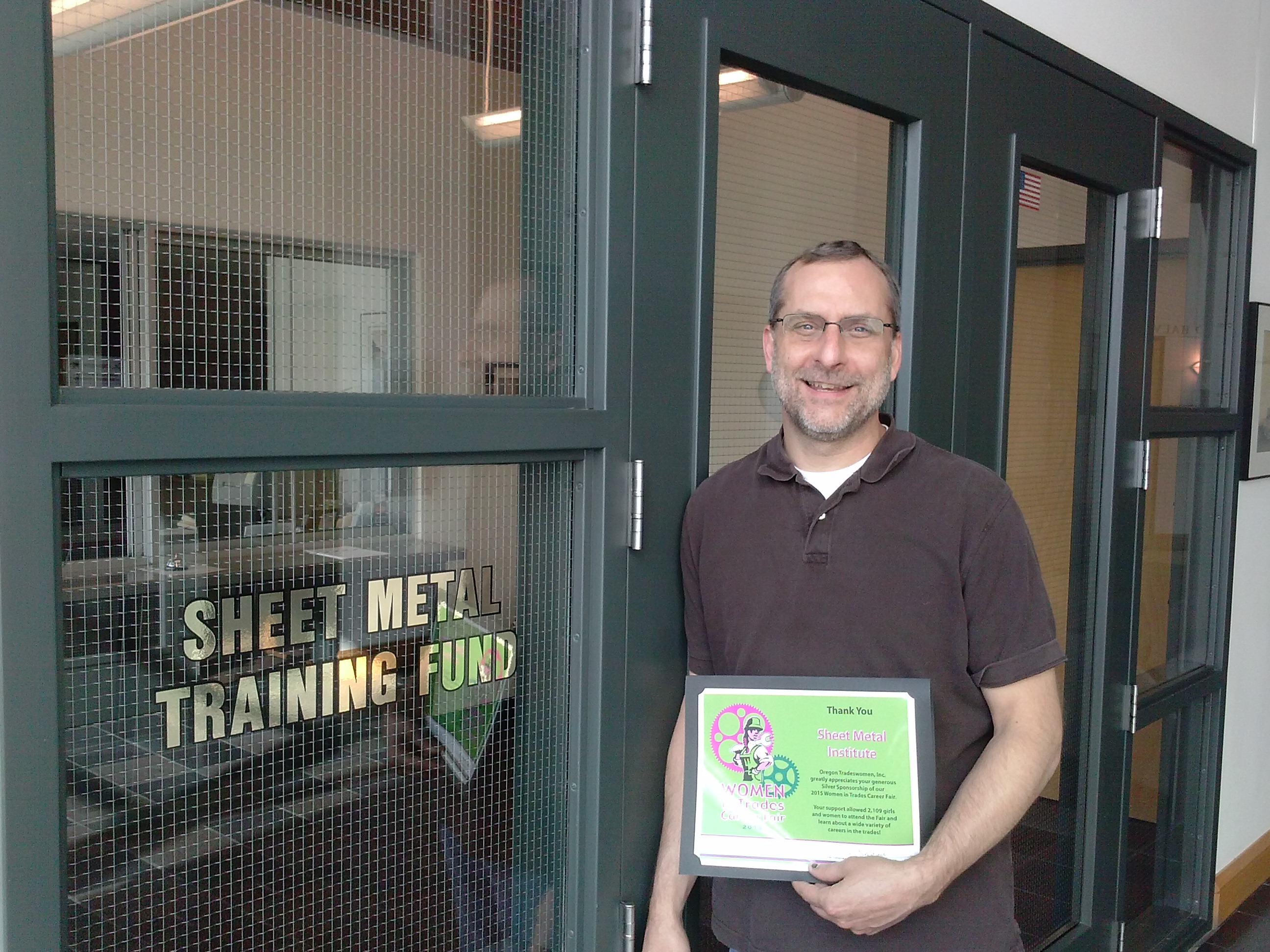 Kevin Roth – Training Coordinator
At the beginning of class, we ask all the students what trade they are interested in. Few students ever say Sheet Metal at the start of class. When they graduate we almost always have women who enthusiastically say sheet metal after visiting the training center. The training staff is VERY patient and are great at explaining how and why they are doing what they are doing when they give them a hands on task. The training center also invests in our students and gives them a hands on experience which is invaluable. The students often tell me….”It was when I got my hands on the tools that I fell in love with the trade.” I love that they invest the time and resources into our students. It really shows their commitment to diversify their trade and I respect that a lot.”
— Kim Neel, Oregon Tradeswomen, Inc.
Thanks to the entire staff of Sheet Metal Institute for their years of support as a field trip host but also for their long standing support of our annual Women in Trades Career Fair. If you want to learn more about their programs, see their web site for complete details.
— Dennise M. Kowalczyk, Development Director
Business Membership Spotlight: Hamilton Construction

Oregon Tradeswomen, Inc. welcomes the support of the business community to help us fulfill our mission to engage more women and girls in the trades.
Hamilton Construction is one of our partners in this program and we thank them for their contribution to OTI.
Hamilton Construction has been meeting clients needs since 1939. It has grown from a small firm building concrete roads and irrigation systems in Oregon, to a corporation performing over $100 Million annually in concrete and steel construction throughout the Western states. During this time, Hamilton has met the demanding needs of both public agencies and private firms, including Oregon, Washington State, California, Colorado and Alaska DOTs, U.S. Army Corps of Engineers, Union Pacific Railroad, Tri-Met, Weyerhaeuser, Georgia Pacific and Portland General Electric to name a few. They have worked with many of our clients for over 40 years.
OTI thanks the staff of Hamilton Construction for their support of our programming as a business membership program participant!
If you want to learn more about our business membership program, please send an email to dennise@tradeswomen.net for details on how you can be involved.
2015 Willamette Week Give!Guide

Oregon Tradeswomen, Inc. is honored to be part of the 2015 Willamette Give!Guide! The end of year campaign runs November 4th through midnight December 31st.
We are thrilled to have THREE business partners who are matching donations up to $7,500! Thanks so much to Atomic Direct, Enhabit (formerly Clean Energy Works) and Madden Industrial for making this generous pledge of support to help us double the impact of your donation to OTI.
Our business partners have also generously donated cool gifts as special thank you incentives for donors on select days: Cup Cozies, towels, a home energy audit, and court side seats to a Blazer game! These are all in addition to the coupons you receive with a minimum donation as well as the amazing incentives you’re eligible to win when you give a gift on the six Big Give Days! Visit the donate page for a more information about the campaign.
How can you participate?
- Donate! You can donate as little as $10 and it helps out OTI. We have three business partners matching up to $7,500 this year! Here is the link: https://giveguide.org/#oregontradeswomeninc
- Share on Facebook, Twitter, and LinkedIn: Make a post on your social media and encourage your circle of friends to donate. You can also share OTI’s posts on Facebook, retweet on Twitter, and we have an Instagram account (@oregontradeswomen).
- Send an email to friends and family! Example: “I am a big fan and supporter of Oregon Tradeswomen. The non-profit does a lot of great work for tradeswomen and it is one of the organizations in this year’s Willamette Week Give Guide. The Willamette Week Give Guide picks non-profits to spotlight in a special publication in order to build awareness and financial support during the end of the year. OTI has three business partners matching up to $7,500 this year so every donation – whether it is $10 or $100 – is matched until OTI reaches $7,500. That means, $7,500 donated by folks like us becomes $15,000 because of the match. It is really easy, too. Just click on the link below and make your secure donation and tell all your friends, too! Thank you!!!”Here is the link to donate:
https://giveguide.org/#oregontradeswomeninc
If you are currently a supporter of Oregon Tradeswomen, thank you so much! If you are able, please help us meet and exceed the matching funds from our incredible business partners and empower OTI to educate, train, and place even more women into satisfying, living-wage careers in the construction trades.
Thank you!
Special Event
Our executive director, Connie Ashbrook, and a few former board members are coordinating a special fundraising event for Oregon Tradeswomen, Inc.
November 14, 2015
Details: A special screening of the new short film Sista in the Brotherhood portraying the challenges and successes of an African American woman carpenter apprentice. This film was created by former OTI staffers Dawn Jones Redstone and Roberta Hunte.
**Invite Only**
If you would like to make a donation, please click here – thank you!
National Women in Apprenticeship Day Social Media Campaign

It’s great that you are as excited as we are about National Women in Apprenticeship Day, Thursday November 5, 2015. Thank you for joining us to make the presence of women in apprenticeship known far and wide. We all know that apprenticeship itself is a very misunderstood concept and within that system, women are unseen. In order to bring this issue to the forefront, we have some tips for a Facebook post to contribute to the campaign and a national conversation. The tips below will give you a chance to let your friends and family know what you do, while connecting to other tradeswomen to create a larger impact!
Anatomy of the Facebook Campaign Post:
In order for you post to have the most effect, make sure that you specify for these posts to be ‘public’.
The Photo:
For this campaign, let’s show the world that women in apprenticeship work! Include a photo (or a video if you have it) of yourself on a job site or doing trades work. Here are some samples to inspire you!
The Text:
You should talk about your experience, your life, your apprenticeship. You want to let your networks know what you do and what that means to you! So, we aren’t crafting your post for you. However, here are some tidbits we are trying to highlight:
- Announce the first ever National Women in Apprenticeship Day, Thursday, November 5th, 2015
- Explain that apprenticeship means you get an education and paid on the job training!
- Talk about getting a life-long career, not just a job
- Share your story, about how apprenticeship changed your life
- Let folks know that women only comprise 3% of apprentices, nationally
The ‘Hashtag’ (or the connection to a larger campaign!):
Hashtags are an important and essential part of creating a Facebook campaign. When you tag organizations or include hashtags, the connected flurry of activity means that those posts get seen more frequently. Then more people share your post, and the impact grows! So, don’t forget to include some hashtags.
- Essential Hashtags:
- @OregonTradeswomenInc
- #WomenInApprenticeship
- Hashtags for Extra Lift:
- #Tradeswomen
- #NAW2015
- #20PercentBy2020
- Tagging to Bring Your Union/Employer into the Circle:
- Like your employer or local union and use – @EmployerFacebookAccountName
- Like your international union and use – @InternationalUnionFacebookAccountName
Take it to the next level!
Add the Twibbon look to your Facebook and/or Twitter Account:
Over the past couple of months, you may have seen people change their profile pictures to have an overlay image. Maybe it was for Planned Parenthood with a pink picture that said “#StandwithPP” or Domestic Violence Awareness with a purple tint and a ribbon. Well, we now have a Twibbon for Women in Apprenticeship! It is a white hardhat that will go over the top of your current profile picture on either Facebook or Twitter. To use this, go to Twibbon and search “Women in Apprenticeship”. Click on the link and allow it to access your Facebook or Twitter and the website will take care of the rest for you!
Bring the Conversation to Twitter:
For those of you who are active on Twitter already you can craft a short post ( I am #WomenInApprenticeship). Here are some rough ideas for people to tag that you could use on Twitter (in addition to those above!):
Your State Governor, State Labor Commissioner, or State Department of Labor
US Department of Labor, Valerie Jarrett (Chair of the White House Council on Women and Girls), Labor Secretary Perez
Together, we can use National Women in Apprenticeship Day to really bring tradeswomen to the forefront!
How To: Facebook Campaign for Oregon Women in Apprenticeship Day
It’s great that you are as excited as we are about National Women in Apprenticeship Day, Thursday November 5, 2015. Thank you for joining us to make the presence of women in apprenticeship known far and wide. We all know that apprenticeship itself is a very misunderstood concept and within that system, women are unseen. In order to bring this issue to the forefront, we have some tips for a Facebook post to contribute to the campaign and a national conversation. The tips below will give you a chance to let your friends and family know what you do, while connecting to other tradeswomen to create a larger impact!
Anatomy of the Facebook Campaign Post:
In order for you post to have the most effect, make sure that you specify for these posts to be ‘public’.
The Photo:
For this campaign, let’s show the world that women in apprenticeship work! Include a photo (or a video if you have it) of yourself on a job site or doing trades work. Here are some samples to inspire you!
The Text:
You should talk about your experience, your life, your apprenticeship. You want to let your networks know what you do and what that means to you! So, we aren’t crafting your post for you. However, here are some tidbits we are trying to highlight:
- Announce National Women in Apprenticeship Day, 11/5/15
- Explain that apprenticeship means you get an education and paid on the job training!
- Talk about getting a life-long career, not just a job
- Share your story, about how apprenticeship changed your life
- Let folks know, that women only comprise 3% of the trades, nationally
- You can support women in apprenticeship with a donation to your local tradeswomen organization, like Oregon Tradeswomen, Inc. Donors who give a minimum of $10, today, will be eligible to be chosen to win 4 lower-level tickets to a Trailblazers game PLUS a signed jersey from a starter! Learn more at www.tradeswomen.net/donate.
The ‘Hashtag’ (or the connection to a larger campaign!):
Hashtags are an important and essential part of creating a Facebook campaign. When you tag organizations or include hashtags, the connected flurry of activity means that those posts get seen more frequently. Then more people share your post, and the impact grows! So, don’t forget to include some hashtags.
- Essential Hashtags:
- @OregonTradeswomenInc (In order to do this, make sure you already like our Facebook Page.)
- @TradeswomenTaskforce
- #WomenInApprenticeship
- Hashtags for Extra Lift:
- #Tradeswomen
- #NAW2015
- #GiveGuide
- #20PercentIn2020
- Hashtags to Bring Your Union/Employer into the Circle:
- Like your employer or local union and use – @EmployerFacebookAccountName
- Like your international union and use – @InternationalUnionFacebookAccountName
Take it to the next level!
Add the Twibbon look to your Facebook and/or Twitter Account:
Over the past couple of months, you may have seen people change their profile pictures to have an overlay image. Maybe it was for Planned Parenthood with a pink picture that said “#StandwithPP” or Domestic Violence Awareness with a purple tint and a ribbon. Well, we now have a Twibbon for Women in Apprenticeship! It is a white hardhat that will go over the top of your current profile picture on either Facebook or Twitter. To use this, go to Twibbon and search “Women in Apprenticeship”. Click on the link and allow it to access your Facebook or Twitter and the website will take care of the rest for you!
Bring the Conversation to Twitter:
For those of you who are active on Twitter already you can craft a short post ( I am a woman in apprenticeship). Here are some rough ideas for extra hashtags that you could use on twitter (in addition to those above!):
Oregon Governor Kate Brown, Oregon Labor Commissioner Brad Avakian, Oregon Apprenticeship and Training Division
USDOL, US Women’s Bureau, Labor Secretary Perez
Together, we can use National Women in Apprenticeship Day to really bring tradeswomen to the forefront!
Making Connections: Innovative Changes
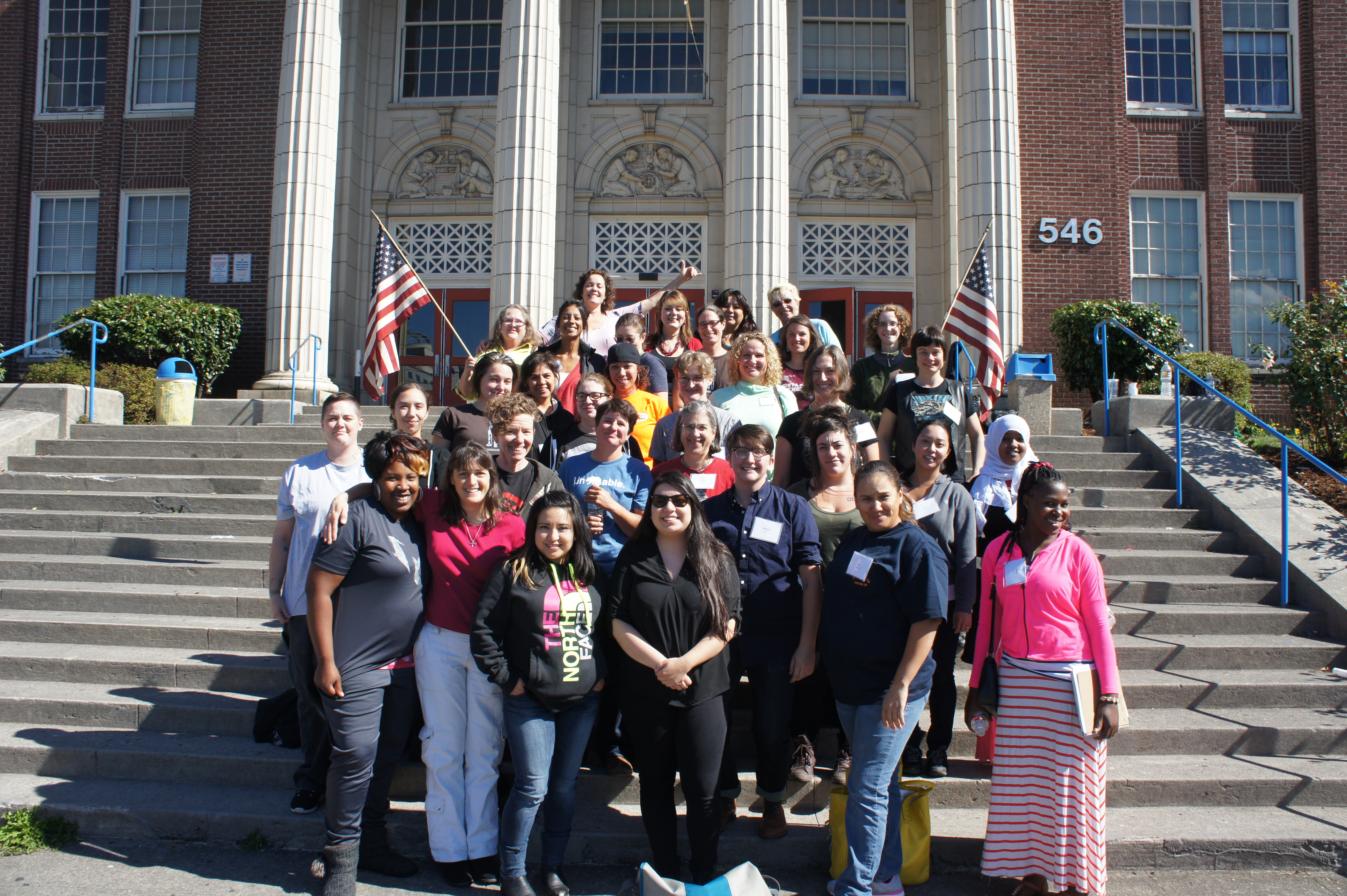
One of the magical moments of working at a non-profit is when you make a meaningful, useful, and unexpected connection. When this synthesis happens between two non-profits, it feels like community happening, the way it is meant to be.
For the second consecutive year, OTI connected with Innovative Changes for the Tradeswomen Leadership Institute. Although, I should pause to clarify, we actually work with them pretty often. On the surface, our missions seem disconnected but we send our students to them for financial planning education when entering the trades.
Innovative Changes assists low-income people build their long-term financial health. OTI is dedicated to promoting success for women in the trades through education, leadership, and mentorship. OTI also serves many low-income women for whom a career in the trades is a pathway out of poverty. Plus, as many of you who work in the trades know, there is a huge transition to make financially when you begin to work in this industry. It is hard to resist a spending splurge when money first starts coming in but it is also difficult to be prepared in the event of a layoff! Innovative Changes help tradeswomen enter and then stay in the trades when they work directly with our students and graduates and also when they present at the Tradeswomen Leadership Institute.
We were so grateful to have their volunteer, Landra Glover return on Saturday, September 26 to talk to attendees about financial planning. Last year, she was so well received that the planning committee was thrilled to have her return. OTI hopes that we can continue to grow and develop this relationship into the future.
As you may know, the Women’s Foundation of Oregon also believes in the work of both of our organizations: OTI and Innovative changes were the two winners of their 2015 Legacy Award. Thank you to WFO for supporting both of our organizations so that we can each have those magical moments of connection and furthering our missions.
– Tiffany Thompson, Advocacy Program Manager