
Danielle Zoller-McKenzie: Iron in the Blood
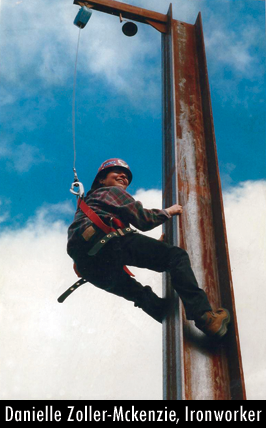
Danielle Zoller-McKenzie has union Ironworking in her blood — she grew up with a dad, brother, cousins and uncles in the trade. But while her family didn’t discourage her from pursuing work in their field, she wasn’t exactly encouraged to try it, either. “They thought I was going to be too small,” she says.
But a summer job as a hodcarrier – or “hoddie”, as she was dubbed by the masons she worked with convinced her she was more than up to the task. “The camaraderie is what I really liked,” she told us. “My brother worked there too. To be a woman and a hard worker is a different kind of feeling than you get than just being a ‘woman worker.’ The praise you get from working really hard, it’s just a big deal.”
After graduating high school, she worked in the shipyards, confirming her love of working in the trades. She applied to the Ironworkers apprenticeship program, and after a year of waiting – somewhat impatiently, she adds — she was in the door.
“I knew when I got into this trade that it’s a man’s world,” Zoller-McKenzie says. She was treated differently by coworkers, held to a different standard. Everyone in the program could see the double standard, but she opted to focus all the more intently on her work in the face of adversity. “It’s always paid off for me to take the high road,” she says. “Although that may not be my first instinct.”
Zoller-McKenzie started her career back in 1998 working on bridges and rebar projects. After two years, she came to Carr Construction, and has worked for the same company ever since, drawing on an enduring network of supportive co-workers rather than surfing from job to job. She says she values security over novelty: “I’d rather wait out the slow times.”
In 2000 as an apprentice, she became eligible to start work on her welding certification and passed the initial training in only three weeks. She pressed on, getting incremental raises and working hard as a “grunt,” as she puts it. She passed her journeyman’s trade certification in 2002 and has since advanced to her current role as superintendent. Through the years she took a number of OSHA classes and is now starting to teach apprenticeship training classes herself.
“I got lucky as a female,” says Zoller-McKenzie. “Because I did make friends and they took me under their wing.” (Continuing in the tradition of paying it forward, she’d like aspiring Ironworkers to know there’s now a smart phone app to aide with the math-heavy art of angle finding. Yes, it’s called Angle Finder.)
Her work has afforded Zoller-McKenzie some memorable times. She’s had a one and a half day welding assignment turn into a gig that lasted over a year, and a job in Terrebonne, Oregon for which she got to do her work 150 feet off of the ground.
The job is not without its downsides – Zoller-McKenzie says the weight of working outside in all weather conditions is getting hard to bear as her body ages. And she says she’s had to sacrifice any semblance of a “normal” family life: “The crazy schedule of this job demands pretty much 15 hours a day.”
But she likes this work. Zoller-McKenzie’s career path has taken her from journey-level worker to crew supervisor — nowadays she also performs crew foreman duties as needed, delegating tasks and being responsible for safety compliance.
She’s proud of what she does. She makes good money and, as she tells us in our interview “the kind of fun you can have on a job is unbelievable.” Looking forward, she has plans to pursue her OSHA safety supervisor certification, and would love to work as an engineer for that agency one day.
This multi-generation Ironworker’s advice to new female tradeswomen? “There’s always going to be some guy who will blow you off because they don’t believe women should be in this job. Have a thick skin. Accept what is, and find the positives.”
Dan Rodriguez: A heavy equipment operator who lives lightly
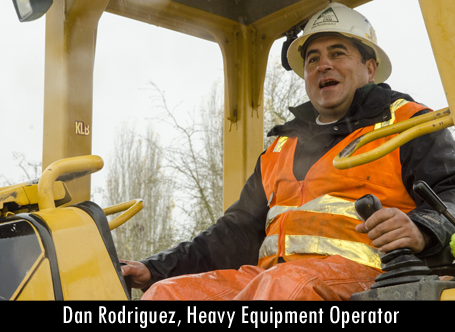
Dan Rodriguez says he’s pretty happy having spent the past 23 years being, as he likes to call it, “a dirt hand.” After meeting the guy, you tend to believe him – he’s led quite a life mastering the art of operating heavy equipment.
The expert dozer and scraper operator has his father to thank for his well-suited career – his dad suggested Rodriguez sign up with Local 701 Operating Engineer Union for heavy equipment operator training decades ago, after Rodriguez had spent his first five post-high school years indoors at a machinist shop.
“I learned I actually liked the smell of diesel engines and working with dirt,” the Klamath Falls native tells us.
Young Rodriguez moved to Eugene for his first trainings with Operating Engineers Local 701 – the first journey in a career that would bring a lot of traveling for the small town boy. A short time later, he wound up moving again. This time, it was to Boardman, Oregon, where he completed his pre-apprenticeship training. At the time, Rodriguez was working as an oiler. (It was several years before he “got into the seat.”)
Those first few days in Boardman, Rodriguez realized that education would be an ongoing process in this line of work. “They put me on a job where I was responsible for maintaining and greasing the plant and the equipment,” he says. “I had to figure out so much that at first, it took me 19 hours to get it all done. But I stuck with it, and later I was able to complete all the work in six hours.”
After putting in time as a crane oiler at Bonneville Dam, Rodriguez went to work for Kiewit Construction, where he spent 15 years. It took him six or seven years to complete his apprenticeship there, but he didn’t mind – the important thing was that he was staying busy. Three mentors took him under their wing and made sure he was consistently employed and accumulating new experience. They kept moving him from job to job and place to place, picking up new skills as he went along.
Those kinds of valuable connections with coworkers, Rodriguez learned, meant a lot when jobs lead to days and weeks away from home, staying in temporary living arrangements that afford you moments to really connect with your fellow workers.
“We get to talking, and, of course, we can’t help it,” Rodriguez reflects on these off-the-clock moments. “Pretty soon, we’re talking about this or that about our jobs. That’s been a great way to learn.” His work has led him to bunk down in a Lakeview, Oregon “man camp”, his own motor home for many years, in Astoria, and eventually, in Hawaii for a lifechanging three-year stint.
There’s something to be said for island living. “In Hawaii, I really learned a lot about working with people from many different cultures,” says Rodriguez. “It was a real adjustment getting used to the pace of work and life there.” He learned that he could “chill out a little” and still get his work accomplished, sans stress.
During his career, Rodriguez has moved from oiler to operator to crew chief to foreman – he’ll take the lead job when it’s requested — but he prefers “being in the seat.” “There is more to life than just working all the time,” says a man who prefers to spend his off hours with his girlfriend and her child over worrying about his career.
“Travel is a part of the life,” Rodriguez likes to say. His ability to adapt to new ways of doing things continues to serve him well in his professional life. “Each company has a different culture, too” he says. “For instance, one place really put a high value on keeping the equipment and vehicles clean and maintained. But at another outfit, they didn’t expect you to spend your time on much of that. They just assumed you’d be pretty rough on the equipment if you were really getting out there and working hard on your job.”
There is one consistent priority — safety. “You learn about safety every day,” he says. “Especially when people are operating big machines alongside of you, right next to your feet.” Rodriguez should know – he’s logged 25,000 workplace hours without an accident, advising new workers to be cautious because it can be easy to misjudge hazards when operating heavy equipment.
Advice to new workers from an old dirt hand? “Help others and along the way, never forget where you came from – that you were new once and everybody is always learning something.” Rodriguez adds his bottom line with a smile: “do the best job you can, but it’s okay to chill out a little too.”
Meet Renee Beaudoin, Apprentice Carpenter
One of the first projects that Portland’s Renee Beaudoin got involved in after graduating from Oregon Tradeswomen, Inc.’s (OTI) Trades and Apprenticeship Career Class (TACC) in 2011 was making phone calls to U.S. legislators. She was part of a team urging Senators and Congresspeople to support hiring women and people of color to work on the Edith Green-Wendell Wyatt Federal Building modernization project.
She chuckles at the memory: “And then I ended up working here – kind of funny.”
It’s also a kind of linking of eras. One of the building’s namesakes, the late Oregon Congresswoman Edith Green, may be best known for Title IX, the part of the 1972 Higher Education Act that prohibited federally funded colleges and universities from discriminating against women. Title IX also opened the doors for girls to attend “shop” classes.
In high school, though, Renee was on a track toward healthcare. “I thought I wanted to do nursing or something like that,” she says. “I went through the whole health occupational program at Benson High School, but I didn’t ever look for any type of job in the healthcare industry.” Renee didn’t discover the trades until later, when she was serving a prison sentence and learned about OTI’s TACC program.
Now Renee is one of hundreds of tradespeople working on the modernization project, which will make the Edith Green-Wendell Wyatt building only the fifth LEED-certified federal building in the country. LEED stands for Leadership in Energy and Environmental Design and the certification, developed by the U.S. Green Building Council, focuses on the design, construction and operation of high performance green buildings, homes and neighborhoods. This effort is classified as a federal “mega project” because the budget is over $50 million, its impact on the economy, the community, and its duration of more than two years. “It’s good to be part of the team. I look around and I see other women,” Renee says. “I feel really proud – I wish there were more (women on the project).”
In the program Renee is part of, a worker advances to the next level, or “term”, after 750 hours on the job, as a member of the carpenters union, Renee’s career is just getting started – and she loves it. “I’m excited that I’m going to be learning,” she says. “I’m just now at the very beginning of my career. Even my boss, who has been at it for 20 years now, says ‘I still learn something new every day.'”
Learning new things seems to come naturally to Renee. Once she found out about OTI, she was set to go. “I was really focused and knew exactly what I wanted to do,” she says. “But I didn’t know about the union or anything until I went through OTI’s TACC program.”
Renee is earning approximately the same weekly wage she was earning at her last job, working retail at a mall, but she is a lot happier. “Plus, I know I’m going to be moving up (in pay grade),” she says. Journey-level carpenters can make up to $32.00 an hour.
Renee added, “At the end of the day I can look back at all the work that I did for the day. And it’s like, cool, look at what I did!”
Meet AJ Banuelos, Laborer
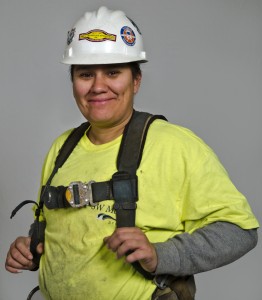
AJ Banuelos, Laborer
AJ Banuelos is a woman on a mission: She is determined to succeed both as a worker and as a mother, and is forth-coming on both topics. She laid out her life plan while tending her two sons one sunny May afternoon.
Growing up along the West Coast, from Seattle to Southern California, AJ finally settled in Portland. She graduated from high school and took some college courses, despite having her first child, a special-needs daughter, at age 18. Her early career involved office and clerical work, but AJ descends from a long line of union-oriented construction workers, “Construction chose me,” she says. She soon recognized that union construction work pays from 2 to 3 times more than clerical. She had gotten as far as certifying and working as a flagger – hazardous work – before she began training at Oregon Tradeswomen Inc. in January 2011, subsequently achieving union apprenticeship.
AJ took up the family trade but with a twist. Everyone else in the family entered building construction; AJ is a member of Laborer’s International Union of North America, Local 320-Roadway and Highway. She moves earth on rail crews, grading and elevating rail. Why? “Because roads and bridges nearly always need repair and building, whereas building construction stops and starts.” The only downside she sees is weather. Despite the fact that AJ is not working currently she has a positive view both of the path she’s chosen and of her future.
Of her decision to apply to OTI and the outcome, she can summarize it in one word: “Awesome!” Her class of 42 was record-sized. The women both challenged and assisted each other and many of them still communicate. AJ continues to volunteer with OTI because she likes the idea of women helping women.
AJ is rightly proud of what she’s learned on the job: Her favorite story from the rail crew shows a lot of ambition. She said she noticed that the foreman would be holding tools, so she would say to him, “you shouldn’t be doing the work.” Then he would teach her how to use that tool. She gained a lot of training through observation. Nonetheless, her proudest work-related accomplishment is becoming a union member.
Family life sounds hectic but organized. On work days she gets herself and the kids ready to go, takes them to school/care and herself to work, always 20 minutes early. Her shift was 7:00 am to 3:30 pm. After work she picks them all up for scouts, football, church, union meetings, and OTI meetings, depending on the night. She is very particular about her children’s activities and television viewing habits, making decisions that will help them grow in mind and body.
She looks to the future: AJ hopes to become a union delegate and attend regional and national conferences. To those who scoff at the idea of women in trades she says, “You haven’t met US!” To other women she advises, “Consider all options; don’t rule out anything.”
AJ’s two year old gets fussy and she scoops him up and pops a berry she’s prepared into his mouth, never missing a beat. “I want my children to be happy and successful,” she says, “to do what their hearts desire and to be satisfied with their decisions.” They surely will be if they follow their mother’s advice: Know the difference between need and want. Don’t want what you can’t have; don’t do something just because you want to; don’t go anywhere just because you want to. Be happy with what you get by working for your goals. Sounds like a recipe for success.
Welcome to the OTI Blog
Welcome to the Oregon Tradeswomen, Inc. Blog, made possible through generous funding from the Oregon Department of Transportation (ODOT). This blog will tell the stories, successes and challenges of women working in the highway construction trades in Oregon. We welcome and encourage your feedback in the comments section and hope that these stories will start conversations, provide you with some advice and perhaps event entertain you.
Stay tuned for profiles of tradeswomen in Oregon, coming soon!